


Shedeur Sanders: Future Star or Career Backup?
- Ryan McCrary

- Dec 25, 2025
- 9 min read

The Cleveland Browns have had a rough season this year, and it looks like the team will have a top-five pick for the second year in a row. Despite this, they are being discussed a lot in the media due to their rookie quarterback, Shedeur Sanders, who became the team’s starting quarterback a few weeks ago.
Sanders is a polarizing player. Many Browns fans are huge fans of his and think he deserves a chance to be the team’s starting quarterback next season. A lot of people aren’t bullish on him, though, and believe the team needs to look at getting another quarterback, even if it requires drafting one in the 2026 NFL Draft.
What should we make of Shedeur Sanders’ performance this season? Has he shown that he can be a quality starter in the NFL or should the Browns look to make a quarterback change during the offseason? Let's dive in and find out.
Questionable Accuracy and Decision Making
The first things I want to highlight that I believe are Sanders’ biggest issues at the moment are his accuracy and decision-making.
Sanders was a very accurate passer in college, allowing him to complete 71.8% of his passes across two seasons at Colorado. This season, though, his accuracy has taken a step back. For example, he has an adjusted completion percentage of 68.5%. This stat is very important because it adjusts a quarterback’s completion percentage for drops, which are out of their control.
Sanders’ adjusted completion percentage ranks 44th in the NFL. Now, let’s incorporate some context because there are a few factors that affect a quarterback’s adjusted completion percentage. One of those is aDOT, or average depth of target. This stat measures how far down the field a quarterback throws on average. A high aDOT will naturally cause a quarterback to complete fewer passes because deep passes are more difficult to complete than short passes.
Sanders has an aDOT of 7.4 yards, the 35th-best mark in the league. This is not the culprit for his inaccuracy.
Another factor that might be affecting his accuracy is pressure. Sanders faces a ton of pressure as he leads the league in pressure rate, or the percentage of his dropbacks in which he faces pressure. His pressure rate is an insane 50.8%, and he is the only quarterback in the NFL who is facing pressure on at least 50% of their dropbacks.
Here’s the problem, though. His adjusted completion percentage is below league average, regardless of whether he faces pressure or not. His adjusted completion percentage under pressure ranks 33rd in the NFL, and his adjusted completion percentage when the pocket is clean ranks 39th in the NFL. Even when you adjust for how deep Sanders is throwing and how much pressure he faces, the fact is, he is an inaccurate passer.
His decision-making is a huge problem as well. He currently has six passing touchdowns compared to eight interceptions, and having more interceptions than passing touchdowns is clearly a massive red flag.
His propensity for throwing interceptions is absolutely insane. He has thrown an interception on 4.8% of his pass attempts, and this is one of the worst interception rates in the entire league. The only quarterback with a worse interception rate is J.J. McCarthy, who sports an abysmal 5.5% interception rate.
Sanders’ interception rate is historically bad. Pro Football Reference has a stat called interception percentage index, which puts each quarterback’s interception rate on a scale where 100 is league average, and this allows us to compare quarterbacks and their interception rate across eras.
This season, Sanders’ interception percentage index is 57, meaning his interception rate is 43% worse than the league average interception rate in 2025. He is one of 10 first-year quarterbacks in NFL history with an interception percentage index of 60 or below. He is throwing interceptions at an unbelievably high rate.

Another stat I like to look at to gauge a quarterback’s decision-making is turnover-worthy play rate. PFF considers turnover-worthy plays to be plays in which a pass has a high percentage chance to be intercepted, or the quarterback does a poor job of taking care of the ball and fumbles it. This stat doesn’t penalize quarterbacks for interceptions that aren’t their fault, and it punishes them when they throw a bad pass that doesn’t get picked off due to luck.
Sanders currently has a turnover-worthy play rate of 4.9%, and this is the 40th-best mark in the NFL. To make matters even worse, he has a turnover-worthy play rate of 4% when the pocket is clean, and this mark ranks 37th in the NFL.
A play that exemplifies his struggles as a decision maker is his interception vs. the Raiders.
On this play, the Raiders are running cover 3, and the Browns attack the coverage by having two running backs run routes to the flat while their two receivers and tight end run curl routes to attack open windows in the defense.
It’s a good play call that should give the Browns an easy completion since they have three curl routes against two hook zone defenders. However, the curl flat defender at the top of the screen reads Shedeur’s eyes and breaks on the ball, getting an easy interception. Unfortunately, it appears that Shedeur telegraphed where he was going with the football and came back to bite him.
Deep Passing and Mobility
While I think there are major issues with Shedeur Sanders’ game, he does show flashes of real talent, and he isn’t bad at everything.
One of his best traits is his deep ball passing. He currently has a PFF passing grade of 84.8 on throws 20+ yards down the field, a significant improvement over his teammate Dillon Gabriel, who sports a PFF passing grade of just 57.5 on these types of throws.
He had a deep ball vs. the Raiders that blew me away and shows that he has the ability to make big-time throws deep down the field.
On this play, the Browns are facing a 3rd and 8 near midfield with a 7-0 lead in the first quarter, and the Raiders are bringing the heat. The Raiders call cover 0 and blitz seven defenders, trying to overwhelm the Browns' offensive line and generate quick pressure. The Browns try to chip with the tight end to help out Shedeur, but it's not enough.
The Raiders get through the offensive line with ease, but Shedeur scrambles outside the pocket to extend the play. He notices that Isaiah Bond got behind his man on his deep route, and Shedeur unleashes a beautiful deep ball that puts the Browns inside the Raiders' five-yard line. This is excellent playmaking.
To be fair, Sanders still has a long way to go as a deep ball thrower. He currently ranks just 21st in adjusted completion percentage on these passes. Still, this is one area that stands out in his game, and I could see him developing into an effective deep ball thrower in the future.
On top of this, I have been very impressed with Shedeur's mobility. He has always been quite mobile for a pocket passer, and I think this has been his best trait this season.
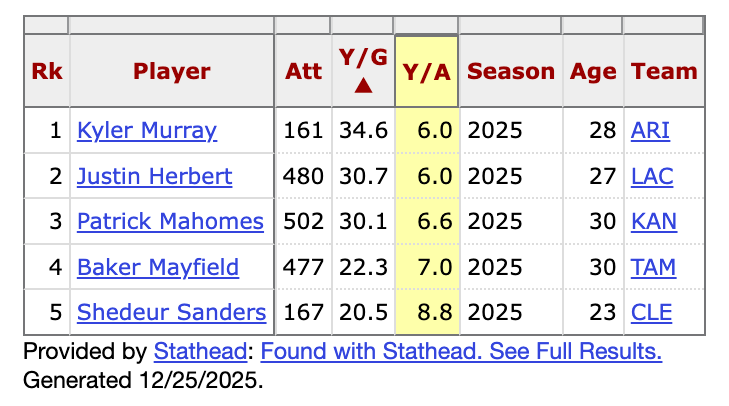
He is currently averaging 20.5 rushing yards per game and 8.8 yards per carry. He is one of just five quarterbacks this year to average at least 20 rushing yards per game and six yards per carry.
Shedeur's mobility comes in handy on plays in which the defense has sound coverage, and he has to create outside of structure. He did this on a big third down vs. the Bills.
This was a huge play for the Browns. They're facing a 3rd and 7 down 13-7 early in the second quarter. Prior to the snap, the Bills showed a single high safety look, and the Browns put a man in motion to determine if the defense was in man coverage or zone coverage. A defensive back followed the receiver in motion, indicating that the Bills might be running cover 1 or even cover 0 with a potential blitz.
However, the Bills rotated their coverage after the snap, transitioning into a two-high safety look, appearing to be playing man coverage with two high safeties and five defenders rushing the passer. The Browns had extra blockers to keep the pressure out of Shedeur's face, but the Bills had a good play call to cover the Brown's two crossers. The Brown's play call might have worked vs. cover 1 or cover 0, but not against cover 2 man.
The Browns gave Shedeur some nice protection on this play, but he had nowhere to throw the football. Thankfully, he was able to utilize his mobility and scramble for 13 yards, picking up the first down and extending the drive.
Another area in which Shedeur's mobility comes into play is avoiding sacks. This was a consistent issue for him at Colorado as he invited pressure but struggled to limit sacks, which can wreck drives for any offense.
He still invites a ton of pressure by holding onto the ball forever. He has yet to have a game with an average time to throw under three seconds this year, and he has the highest average time to throw of 3.32 seconds. Also, he is responsible for 28.9% of his own pressures, according to PFF, the 4th highest rate in the league.
The good thing is, he only has a pressure-to-sack rate of 15.2%. Being under 20% is really good for him, and this shows that he can utilize his mobility to avoid negative plays in the backfield. I'm afraid he may revert to his old ways and start taking a ton of sacks when pressure gets to him. For now, this is a big positive.
Adjusting For Shedeur's Situation
It's no secret that Shedeur Sanders has one of the worst statistical profiles of any quarterback in the NFL. Among quarterbacks with at least 200 plays this season, he ranks near the bottom of the league in advanced stats like EPA/play and completion percentage above expectation (CPOE).

That's obviously not a good sign. Shedeur has shown flashes of real talent, but his overall body of work is quite poor.
Now, a lot of people have pointed out that his situation must be accounted for because his weak supporting cast makes it hard for him to be productive. This is fair and I think it would be irresponsible for me not to mention what kind of supporting cast he has to deal with.
I won't sugarcoat anything. The Browns have arguably the worst offensive structure in the entire league, and it would be hard for any quarterback to be successful in this offense. PFF grades each team in different categories like pass blocking, receiving, run blocking, etc., and we can utilize this data to measure how good or bad Shedeur's supporting cast is.

The Browns have some of the worst PFF grades in the NFL. In fact, they rank dead last in PFF receiving grade and PFF pass blocking grade. The team does have an amazing defense, but their offense is dreadful across the board, and it's clear that Shedeur is not getting much support from the rest of his offense.
This raises a very important question: how do we properly evaluate a rookie quarterback who has a small sample of snaps and is playing with likely the worst offensive infrastructure in the NFL? Honestly, I don't have a great answer.
I will say it is possible to isolate a quarterback's performance and remove factors that they can't control. You can do this by looking at how they perform when the pocket is clean or how they compare to the rest of the league throwing to different parts of the field.
Even when you do this for Shedeur, the results are honestly terrible.
You can look at his best plays and choose to believe that his highlights are who he is. You can factor in the context of how bad his situation is and throw out his poor production because of that. However, the truth is unavoidable. Shedeur Sanders simply isn't playing well, and he is playing like one of the worst starting quarterbacks in the NFL.
What's Next?
Where do the Cleveland Browns go from here? Has Shedeur shown the team enough to give him a chance to be their starter in 2026, or should they look to draft one of the top quarterbacks in the 2026 NFL Draft?
First off, there's a 0% chance that the Browns will commit to Shedeur as their full-time starter after this season. He was a fifth-round pick, even being selected after the team already picked Dillon Gabriel, and he has dreadful metrics across the board. It would make zero sense for the Browns to commit to him, considering his performance on the field.
The Browns probably need to focus on targeting a quarterback with their top pick in the 2026 NFL Draft. Right now, they are slated to have the 3rd pick, but they have a great chance to move up and get the 2nd pick, putting them in position to draft Indiana quarterback Fernando Mendoza or Oregon quarterback Dante Moore.
I haven't done any draft research, so I have zero prospect-related takes yet. However, I am a huge college football fan, and I think both of these quarterbacks are talented and have traits that could allow them to succeed in the NFL. They don't appear to be elite prospects, but they would be better bets to be quality starters than Shedeur does at the moment.
I hope Shedeur Sanders turns it around and has a successful career. However, the evidence is clear that he has not played well enough for anyone to be confident that he can be a long-term starter in the NFL.


Comments